[:fr]Notre ami Jean-Louis LEFAIX, chercheur illustre de la radiobiologie et la radiopathologie française, nous a quitté ce 15 février 2025 à l’âge de 72 ans.
Son parcours a débuté en biologie « mon bureau était un réduit sans fenêtre d’environ 1,50m sur 2 antichambre du bureau de mon directeur de thèse à l’université Pierre Marie Curie » ayant fait ses classes auprès de son maître René Couteau dans les années 70 sur la jonction neuro-musculaire.
Puis, il a soutenu une thèse de 3ème cycle en biologie sur la morphologie descriptive et quantitative du nerf périphérique de la jonction neuromusculaire et du métabolisme musculaire chez la souris (1981, Paris VI). Il a d’ailleurs souffert d’un plagiat de ses travaux, survenu depuis Londres, après une demande de recommandation auprès d’un baron à renommée internationale spécialiste du système nerveux chez la souris !
En avril 80, la chance lui a permis d’être recruté au CEA pour travailler à la « ferme atomique » laboratoire de radiobiologie appliquée. « Bloc sans fenêtre construit au milieu des années 60, de 80 m de long, 25 m de large, permettant l’expérimentation sur gros animaux, dans les bois à la périphérie de INRA à Jouy-en-Josas, dans un isolement géographique et administratif total ».
Ceci a permis, avec en particulier les vétérinaires du laboratoire, de mettre au point un modèle expérimental d’irradiation accidentel localisé (programme Pocket Syndrome) puis de développer une recherche radiobiologique translationnelle en physiologie et en imagerie… suivi d’un doctorat de Sciences (1989).
Puis l’ouverture sur la thématique des séquelles tardives de la radiothérapie est apparue dès l’arrivée du Dr Sylvie DELANIAN au labo en 1990 (suivi d’ailleurs d’une amicale complicité de 30 ans) permettant la précieuse concordance de travaux cliniques, in vivo, et in vitro, avec Michèle MARTIN puis Marie Catherine VOZENIN.
L’ensemble de ses travaux sera couronné par une habilitation à diriger des recherches en 1994 et un dépôt de Brevet d’Invention en 1998.
Puis un virage des années 2000 sera pris à Caen avec l’Hadronthérapie puis le projet Arcade construit pour préparer la radiobiologie du XXIe siècle.
Lorsqu’en 2009, la santé l’a trahi (sans doute lié aux radiations), l’expérience du partage des souffrances de patients avec séquelles de la radiothérapie a pu l’aider à traverser certaines épreuves humaines…. Il a fait partie du premier cercle des fondateurs de l’ARSER en 2010 et son Conseil scientifique.
Il s’estimait être un passeur de savoir d’une discipline complexe à cheval (son ami de toujours) sur la physique, la physiologie animale, la médecine, la biologie moléculaire et la radiothérapie.
Son érudition, sa rigueur, son humour, sa clarté, et même son pessimisme légendaire vont nous manquer. Il a marqué à jamais la radiobiologie et radiopathologie française en permettant les transferts de connaissances du microscope à l’humain et des applications médicales toujours en vigueur à ce jour.
Merci pour tout Jean Louis
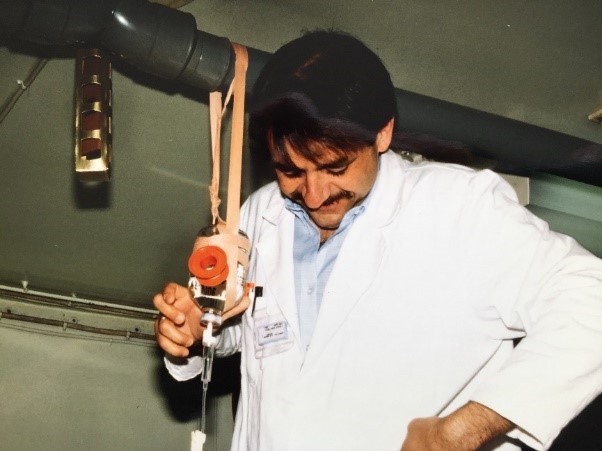
au laboratoire de Jouy en Josas
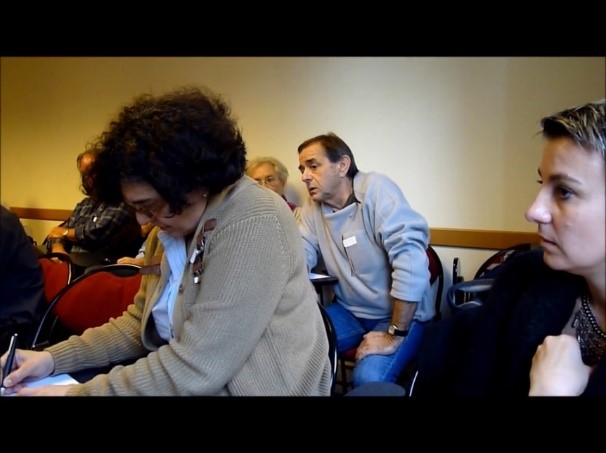
en AG à l’ARSER
[:en]Our friend Jean-Louis LEFAIX, an illustrious researcher in French radiobiology and radiopathology, left us on February 15, 2025 at the age of 72.
His career began in biology « my office was a windowless little room of about 1.50m by 2 antechambers of my thesis director’s office at Pierre Marie Curie University » having studied with his master René Couteau in the 70s on the neuromuscular junction.
Then, he defended a 3rd cycle thesis in biology on the descriptive and quantitative morphology of the peripheral nerve of the neuromuscular junction and muscle metabolism in mice (1981, Paris VI). He also suffered from plagiarism of his work, which occurred from London, after a request for a recommendation from an internationally renowned baron specializing in the nervous system in mice!
In April 80, luck allowed him to be recruited at the CEA to work at the « atomic farm » laboratory of applied radiobiology. « Windowless block built in the mid-60s, 80 m long, 25 m wide, allowing experimentation on large animals, in the woods on the outskirts of INRA in Jouy-en-Josas, in total geographical and administrative isolation ».
This allowed, in particular with the laboratory’s veterinarians, to develop an experimental model of localized accidental irradiation (Pocket Syndrome program) and then to develop translational radiobiological research in physiology and imaging… followed by a doctorate in Sciences (1989).
Then the opening on the theme of the late after-effects of radiotherapy appeared upon the arrival of Dr. Sylvie DELANIAN at the lab in 1990 (followed by a friendly complicity of 30 years) allowing the precious concordance of clinical work, in vivo, and in vitro, with Michèle MARTIN then Marie Catherine VOZENIN.
All of his work will be crowned by an authorization to direct research in 1994 and a Patent of Invention filing in 1998.
Then a turning point in the 2000s will be taken in Caen with Hadrontherapy then the Arcade project built to prepare the radiobiology of the 21st century.
When in 2009, health betrayed him (probably linked to radiation), the experience of sharing the suffering of patients with after-effects of radiotherapy was able to help him get through certain human trials…. He was part of the first circle of founders of ARSER in 2010 and its Scientific Council.
He considered himself to be a transmitter of knowledge of a complex discipline straddling (his lifelong friend) physics, animal physiology, medicine, molecular biology and radiotherapy.
His erudition, his rigor, his humor, his clarity, and even his legendary pessimism will be missed. He forever marked French radiobiology and radiopathology by allowing the transfer of knowledge from the microscope to humans and medical applications still in force to this day.
Thank you for everything Jean Louis
at the Jouy en Josas laboratory
in AG at ARSER
[:]